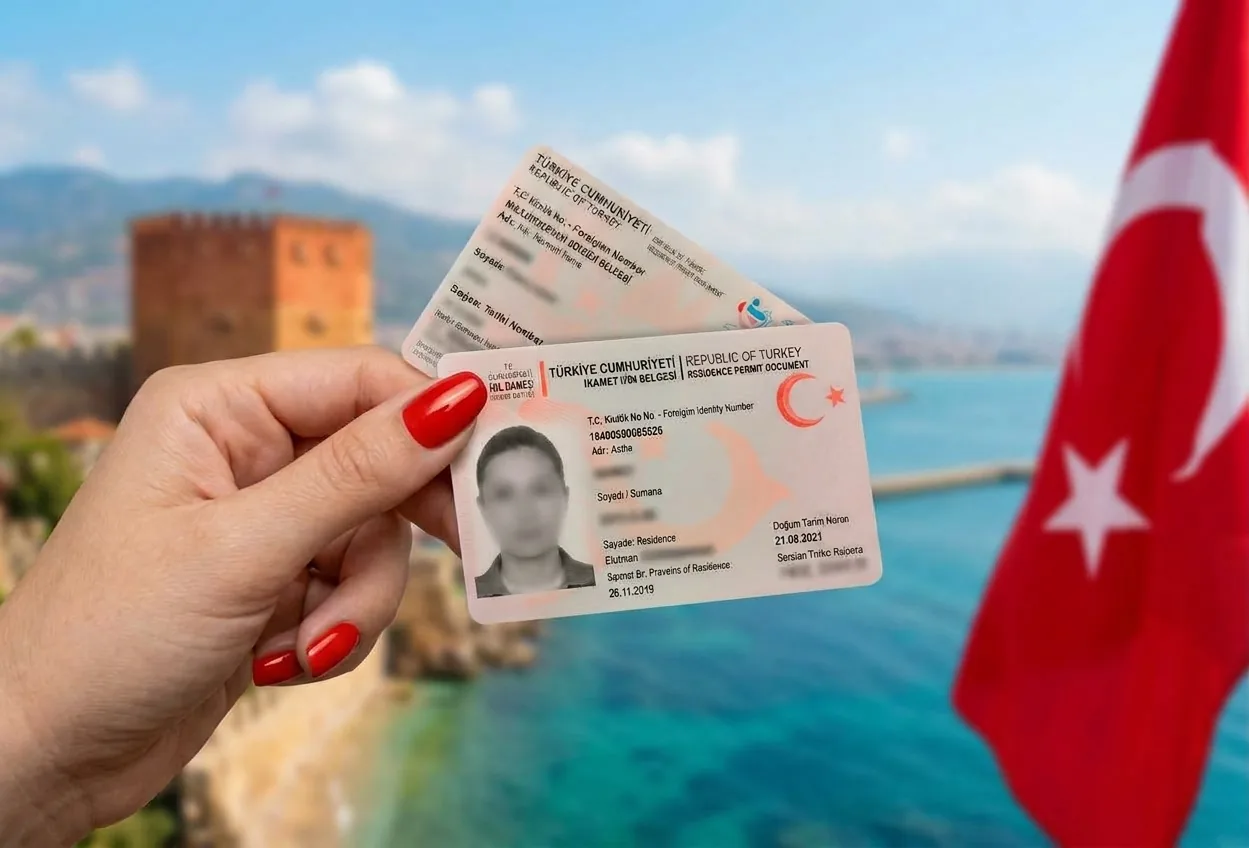
Turkey lets most European, British and North American passport holders stay visa-free for up to 90 days in any 180. That is enough for a long holiday, but not for a winter in Alanya, a year of trying out life on the coast, or a permanent move. For anything longer you need a residence permit — in Turkish, ikamet izni, usually shortened to "ikamet".
Permits are issued by the Presidency of Migration Management (Göç İdaresi Başkanlığı) under Law No. 6458 on Foreigners and International Protection. The law sets out six types of permit, each with its own grounds, maximum duration and pitfalls. Apply under the wrong one and the application is refused, the fee is lost, and the clock on your visa-free days keeps running.
This guide walks through every type as it works in 2026: who it is for, how long it lasts, what it costs and where applications tend to go wrong. There is a comparison table at the start and an FAQ at the end.
Turkish residence permit types at a glance
| Permit | Turkish name | Max. term per issue | Typical applicant |
|---|---|---|---|
| Short-term | Kısa dönem ikamet izni | up to 2 years (up to 5 for investors) | tourists, property owners, business people, patients, language students |
| Family | Aile ikamet izni | up to 3 years | spouses and children of Turkish citizens or legal residents |
| Student | Öğrenci ikamet izni | length of the course | students at Turkish universities |
| Long-term | Uzun dönem ikamet izni | indefinite | 8 years of continuous legal residence |
| Humanitarian | İnsani ikamet izni | up to 1 year | exceptional cases, by decision of the governor |
| Victims of human trafficking | İnsan ticareti mağduru ikamet izni | 30 days, renewable | by decision of the authorities |
A work permit (çalışma izni) is technically a separate document, but it doubles as a residence permit. More on that below.
Short-term residence permit (kısa dönem ikamet izni)
This is the permit almost every foreigner moving to Alanya, Antalya or Istanbul without a Turkish employer or Turkish family ends up with. It is issued for up to two years at a time and can be renewed as long as the reason for staying still applies.
Article 31 of Law No. 6458 lists the grounds:
- scientific research;
- owning residential property in Turkey;
- business connections or setting up a business;
- on-the-job training;
- educational or cultural exchange programmes under international agreements;
- tourism;
- medical treatment (unless it poses a public-health risk);
- a request from a court or public authority;
- switching from a family permit whose conditions no longer apply;
- Turkish language courses;
- training programmes run by public institutions;
- the first six months after graduating from a Turkish university;
- investment at a level set by presidential decision (up to 5 years);
- citizenship of the Turkish Republic of Northern Cyprus (up to 5 years).
In practice, three grounds account for most applications from people relocating to the coast: tourism, property ownership and renting.
Tourist residence permit
The "tourist ikamet" is the short-term permit granted for tourism. It suits people who want to spend a season or a year in Turkey before deciding whether to buy.
What to expect in 2026:
- the migration office wants to know where you will live, when and for how long. In practice this means an address backed by a rental contract or accommodation booking;
- the first tourist permit is usually granted for less than the two-year maximum, often for up to a year;
- renewals are scrutinised more closely than first applications, especially in big cities and areas popular with foreigners. Living in Turkey for years on back-to-back tourist permits is no longer realistic.
Treat a tourist permit as a bridge, not a long-term solution.
Residence permit through renting
There is no separate "rental permit" in the law. A permit "based on a rental" is the same tourist short-term permit, with your address proven by a lease. The lease is normally notarised, and the address is registered in the national address system (adres kayıt).
The biggest risk is closed neighbourhoods. Where foreigners make up more than a set share of residents (20% since 2022), new address registrations for foreigners are blocked, so you cannot apply with an address there. Check the neighbourhood before you sign a lease. The list changes: according to the chairman of the Alanya Chamber of Commerce and Industry (ALTSO), Mahmutlar, Kestel, Avsallar and Kargıcak reopened for registration in June 2026.
Residence permit by buying property in Turkey
Owning a home in Turkey entitles you to a short-term permit based on your title deed (tapu). It is the most stable ground: as long as you own the property and actually live in it, renewals do not depend on proving a "purpose of visit".
The rules in 2026:
- minimum value of USD 200,000 for property bought on or after 16 October 2023, the same everywhere in Turkey;
- property bought between 26 April 2022 and 15 October 2023 keeps the old thresholds: USD 75,000 in metropolitan provinces (büyükşehir) — which includes the whole of Antalya province and Alanya — and USD 50,000 elsewhere;
- the value must be confirmed by a valuation report from a firm licensed by the Capital Markets Board (SPK), showing a market value at or above the threshold;
- the property must be residential (mesken). Commercial units and land do not qualify;
- payment must go through a bank, with a foreign-exchange certificate (DAB). Cash deals do not count;
- one property supports one owner's permit. A spouse and children under 18 apply for family permits as the owner's dependants.
Do not confuse this with citizenship by investment. Turkish citizenship requires a property purchase of at least USD 400,000 and follows a separate procedure — see Turkish citizenship by investment.
Finding a property that meets the value threshold, sits in a neighbourhood open to registration and passes the residence permit checks is exactly what we do. Our page on residence permits through property purchase explains how we handle the deal through to your ikamet card. Properties that qualify are in our Alanya property catalogue.
Other short-term grounds
- Business. For founders and partners of Turkish companies and people with documented business ties. It does not give the right to work as an employee.
- Medical treatment. Issued for the length of treatment, based on documents from a Turkish clinic.
- Turkish language courses. For students at accredited language centres. The number of permits on this ground is limited, so it cannot be renewed indefinitely.
- Investment. For investors at the level set by presidential decision; issued for up to five years.
Family residence permit (aile ikamet izni)
The family permit is for relatives of a Turkish citizen, of a foreigner holding a residence or work permit, or of a refugee. It is issued for up to three years at a time, but never for longer than the sponsor's own permit.
Who can apply:
- a spouse;
- minor children, including stepchildren and adopted children;
- dependent adult children.
Most conditions apply to the sponsor:
- total income of at least the Turkish minimum wage, and no less than one third of the minimum wage per family member. In 2026 the net minimum wage is TRY 28,075 a month;
- housing suitable for the size of the family;
- health insurance covering every family member;
- at least one year of legal residence in Turkey (not required of Turkish citizens);
- no conviction for an offence against family members in the last five years.
Marriages are checked. A marriage of convenience leads to cancellation of the permit and an entry ban.
Two useful details: children who held a family permit for at least three years before turning 18 can switch to a short-term permit as adults, and the foreign spouse of a Turkish citizen can apply for citizenship after three years of marriage — see Turkish citizenship: how to get it.
Student residence permit (öğrenci ikamet izni)
Issued to foreigners on associate, bachelor's, master's or doctoral programmes at Turkish universities, for the length of the course and renewed yearly while student status continues.
Keep in mind:
- a student permit does not give the right to work. Bachelor's students can work only after their first year, with a work permit and limited hours;
- years on a student permit count half towards the eight years needed for a long-term permit;
- school-age children at Turkish schools are covered by a family permit with their parents, not a student permit.
Language courses are a short-term ground, not a student permit.
Long-term residence permit (uzun dönem ikamet izni)
Turkey's equivalent of permanent residence. The card has no expiry date and does not need renewing.
Requirements:
- at least eight years of continuous legal residence in Turkey (student years count half);
- no state social assistance in the last three years;
- sufficient, stable income for yourself and your family;
- valid health insurance;
- no threat to public order or security.
The migration authority decides with the approval of the Ministry of Interior. Long-term residents enjoy most of the rights of Turkish citizens, except voting, military service, public service jobs and duty-free import of vehicles.
The one serious restriction: spend more than one continuous year outside Turkey and the permit can be cancelled, unless the absence was for health, education or compulsory service in your home country.
Working in Turkey: the work permit (çalışma izni)
There is no "work ikamet". If a Turkish employer hires you, they apply for a work permit through the Ministry of Labour and Social Security, and that permit counts as a residence permit for as long as it is valid.
None of the residence permits above — tourist, property, family — gives the right to take a job. Working without a permit means fines for both employee and employer, followed by deportation.
The Turquoise Card (Turkuaz Kart) is a separate route for highly qualified professionals, investors and scientists. It gives an indefinite work permit, which becomes permanent after a three-year transition period.
Humanitarian permit and permit for trafficking victims
You cannot simply choose to apply for these.
A humanitarian permit is granted by the governor's office with the approval of the Ministry of Interior when no other permit can be issued — for example, when deportation is impossible, return is unsafe, or a child's best interests require it. It is issued for up to a year and can be renewed.
A permit for victims of human trafficking gives 30 days to recover and decide whether to cooperate with the authorities, and can be extended.
How to apply for a Turkish residence permit
The process is the same for every type:
- Fill in the online form at e-ikamet.goc.gov.tr. This is the only official application site. An agent can help with paperwork, but the form is always filed there.
- Book an appointment at the provincial migration office; the date is assigned when you submit the form.
- Pay the card fee and the permit fee. In 2026 the card costs TRY 964 for everyone. The permit fee (harç) depends on your nationality and the length of the permit, and the system calculates it automatically. Citizens of some countries — including Denmark and Ireland — are exempt from the permit fee but still pay for the card.
- Attend in person with your documents. The full list for each ground is in Turkish residence permit documents: a checklist.
- Track your application on the same site under "Başvuru Sorgulama". The legal deadline for a decision is 90 days; in Alanya and Antalya it usually takes a few weeks.
- Receive your card by PTT post at the address in your application.
Apply for your first permit before your visa or visa-free period ends. Renewals can be filed from 60 days before your current permit expires and no later than its last day.
Every application needs health insurance valid for the whole permit period — usually a Turkish policy for foreigners. Nationals of countries with a social security agreement with Turkey may be able to prove cover another way.
What a Turkish residence permit gives you — and what it does not
It gives you:
- legal residence with no visa runs;
- unlimited exits and re-entries while the permit is valid;
- a foreigner ID number (starting with 99), which lets you open a bank account, set up utilities, internet and a Turkish phone line, and use e-Devlet;
- the right to buy and register a car;
- residence time that counts towards a long-term permit and citizenship.
It does not give you:
- the right to work (only a work permit does);
- Schengen access. An ikamet is not a Schengen visa, although you can apply for one from Turkey as a resident;
- the right to vote;
- automatic permits for relatives — each person needs their own.
Why residence permits are refused or cancelled
The grounds for refusing, cancelling or not renewing a short-term permit are listed in Article 32 of Law No. 6458. The most common problems:
- an address in a closed neighbourhood — the most frequent reason for refusal in areas popular with foreigners;
- no clear reason to stay, especially on a second tourist application;
- using the permit for something else, such as working without a work permit;
- long absences: spending more than 120 days in total outside Turkey in the past year can get a short-term permit cancelled, with exceptions for study, medical treatment and compulsory service;
- errors in the paperwork — the wrong fee, expired insurance, an address that does not match the registration;
- an entry ban or deportation order.
After a refusal you are usually given 10 days to leave the country or apply on another ground. Decisions can be challenged in an administrative court.
Which residence permit should you choose?
- You want to try living in Turkey first → a tourist permit, with an address in an open neighbourhood.
- You plan to buy a home → a property-based permit. A home worth USD 200,000 or more gives the most stable ground, renewable for as long as you own it.
- Your spouse or parent already lives legally in Turkey → a family permit.
- You have a place at a Turkish university → a student permit.
- A Turkish employer has hired you → a work permit instead of an ikamet.
- You have lived in Turkey for eight years → a long-term permit.
- You are ready to invest USD 400,000 or more → Turkish citizenship rather than a residence permit.
If you are looking for a home in Alanya that also works for your residence permit, start with our guide to Alanya's districts — it shows where the international community lives and where the neighbourhoods are quieter and more Turkish. We check the rest before you sign.
FAQ: Turkish residence permits
What is an ikamet in Turkey? Ikamet izni is the official name of a Turkish residence permit. It is a plastic card with your photo, a foreigner ID number, the permit type and its expiry date.
How long is a Turkish residence permit valid for? A short-term permit lasts up to 2 years per issue (up to 5 for investors), a family permit up to 3 years, a student permit for the length of the course, and a long-term permit indefinitely. A first tourist permit is often issued for up to a year.
How long can I leave Turkey with a residence permit? With a short-term permit, no more than 120 days in total in the past year, or it can be cancelled. With a long-term permit, no more than one continuous year.
How much does a Turkish residence permit cost in 2026? The card costs TRY 964. The permit fee depends on your nationality and the permit length and is calculated on e-ikamet when you apply. You also need health insurance, and a valuation report for a property-based permit.
Can I get a residence permit in Turkey by renting? Yes, as a tourist short-term permit with your address proven by a rental contract. The address must be in a neighbourhood open to foreigner registration.
Does a Turkish residence permit allow me to work? No. You can only work legally with a work permit, which your employer applies for.
What is the minimum property value for a Turkish residence permit? USD 200,000 for property bought from 16 October 2023. For purchases between 26 April 2022 and 15 October 2023, USD 75,000 in metropolitan provinces (including Alanya) and USD 50,000 elsewhere.
How do I check my residence permit application status? On e-ikamet.goc.gov.tr under "Başvuru Sorgulama", using your application number, passport and email or phone number.
Sources: Law No. 6458 on Foreigners and International Protection; Presidency of Migration Management (goc.gov.tr, e-ikamet.goc.gov.tr); General Communiqué of the General Directorate of Public Accounts, Official Gazette No. 33117 of 24.12.2025 (card fee). Information current as of October 2026. Rules change, so check official sources or ask us before applying.